The McDonald's Index
The McDonald's Index
ArthurTalks — Post #5 8 minute read
So a good food, literally, for thought is the idea of the Big Mac Index. It's essentially how Big Macs are not priced equally across the globe.
McDonald's is one of, if not my personal all time favourite fast food restaurant. It holds great memories from me growing up, and it's interesting to see how it's viewed differently all over the world.
To get the ole calculator out, I've mapped the average salaries for numerous countries and compared the price of a Big Mac meal as a percentage of a person's daily wage. This is called the Big Mac Index, and it shows how a single burger can vary by region and how it's viewed.

The West: cheap and cheerful "junk"
It's noticeable how it can shift from being fast "junk" food in developed Western countries such as its origin, the USA, the UK and Australia, where it averages at 10% of an average person's daily wage. It is known as food for a drunk night out, surrounded with homeless people at times, something you grab on a road trip, and generally is not painted in a great light.
If you told someone to meet up at McDonald's and hang out for a couple hours it can even be seen as questionable! I never knew that, as I always thought of it as a place to hang out.
The Singapore anomaly
One huge anomaly in this blog post though is Singapore; where the average person's income is higher than almost everyone on this list and yet the Big Mac meal costs as low as 3% of a person's daily wage. At the same time McDonald's culturally has been a place that people go to as a Third Space to hang out and socialise with friends.
With it already being such a cheap and affordable option, it also has the highest amount of deals available on its mobile app, reducing meals by another 40% at times!
The original index
To be fair, the Big Mac Index was actually invented by The Economist back in 1986, and their version measures the burger's price in plain US dollars to compare currencies. On that scale Switzerland is the famous outlier at nearly $8, while Indonesia and India sit near the bottom at around $2.50.
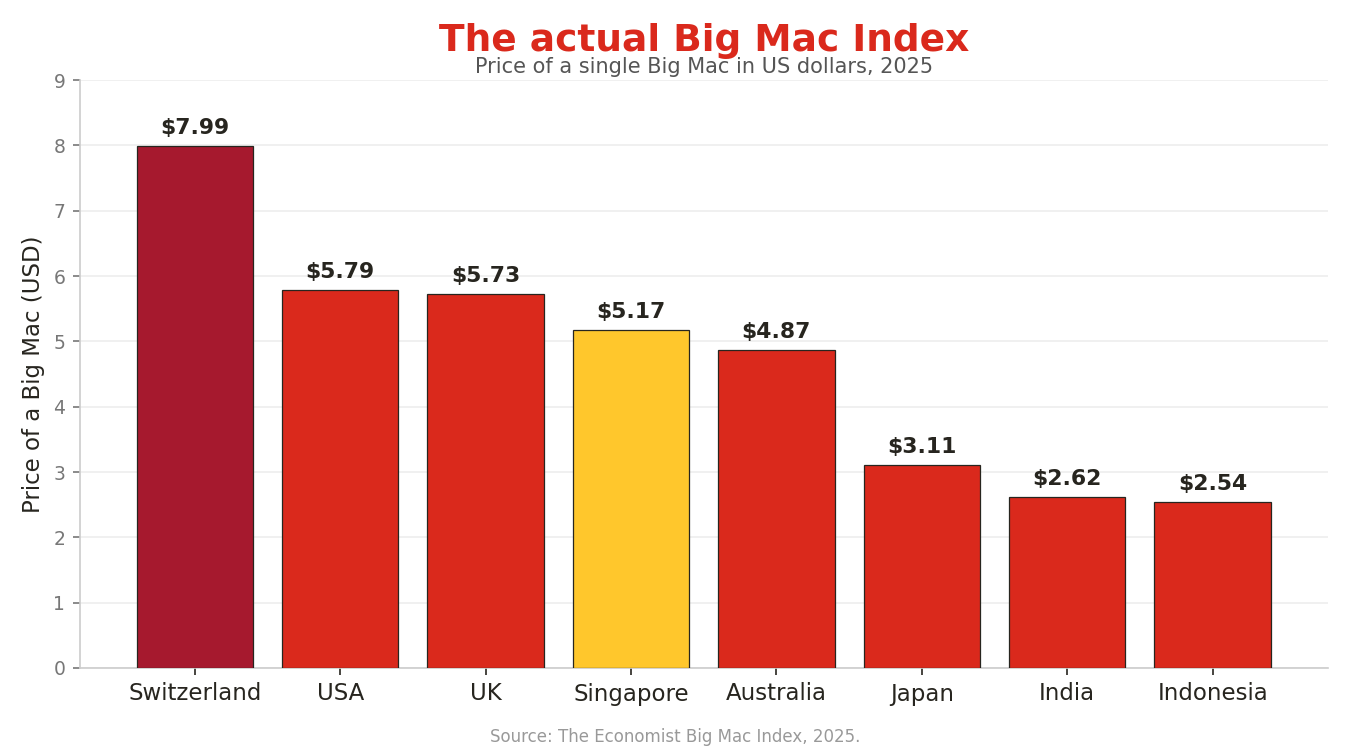
What's funny is that in raw dollars a Singapore Big Mac ($5.17) actually costs more than one in Australia or Japan, and almost as much as in the US. It's only when you set it against the local wage that it flips into pocket change — which is exactly why the wage angle tells such a different story.
The middle class: a safe treat
Then it moves into a middle class of sorts; where it starts to consume a larger portion of people's salaries and falls into a mix of being a luxury treat to some. This is places like Japan, where "Western" food like burgers is already not normal to people's diet, and thus becomes a safe and good choice for locals that want to try burgers and fries.
Japan is a great example of how McDonald's reads the room. Rather than being seen as throwaway junk food, it's treated more like a proper little restaurant — a clean, affordable, slightly novel "taste of America". The first Tokyo store opened back in 1971 with people queuing around the block, and ever since, McDonald's Japan has mastered the art of the limited-time burger. New drops genuinely become national events.
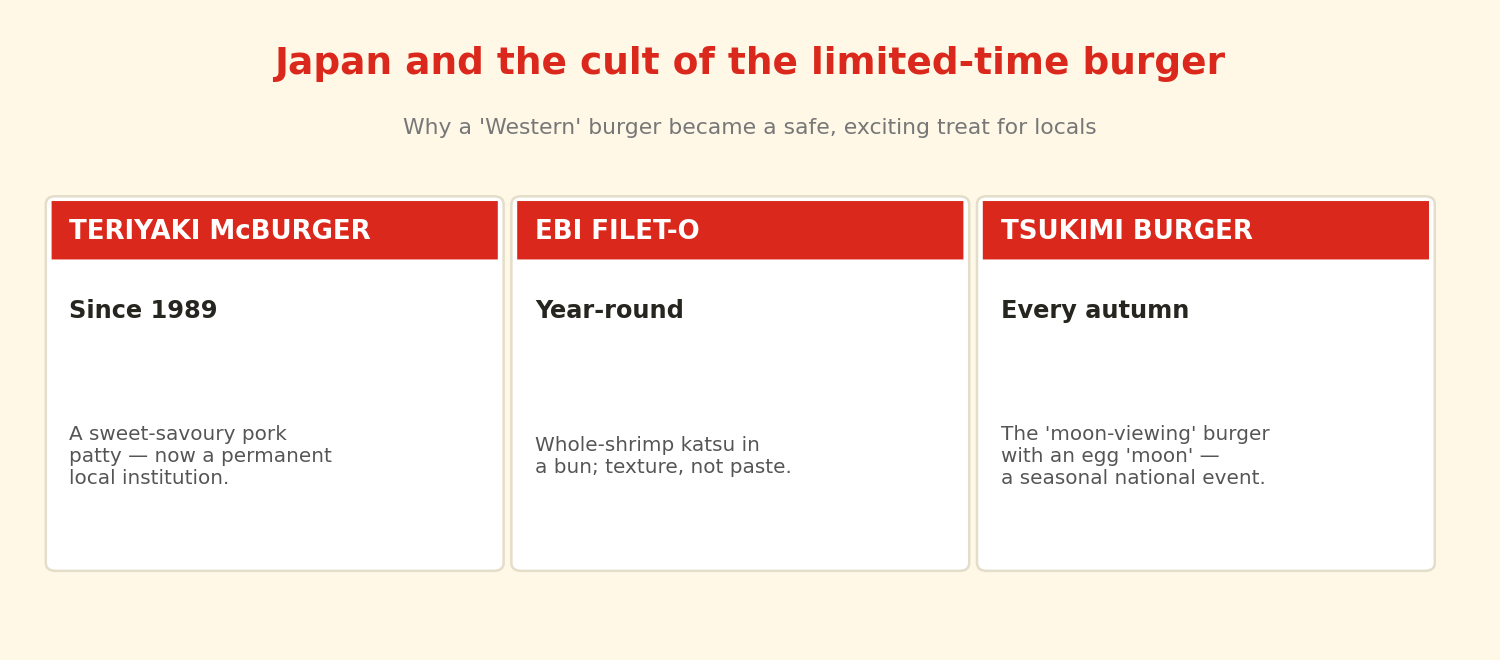
The Teriyaki McBurger has been a staple since 1989, the Ebi Filet-O is a proper whole-shrimp katsu, and every autumn the Tsukimi ("moon-viewing") Burger comes back with its signature egg "moon" to mark the festival. It's the same machine, just tuned so that a burger becomes something you look forward to rather than something you settle for.
The luxury treat
Finally, in countries with the lowest average incomes — let's use Indonesia as an example, where "American" food and "burgers" are not so much the norm — it becomes a luxury treat. The kind of meal that people would go to specially for their birthday and dress up for.
In Indonesia the price of a Big Mac meal can be almost 30–40% of a person's daily wage. This is the equivalent of going for a £50–60 steak dinner to someone in the UK.
Cultural conformities
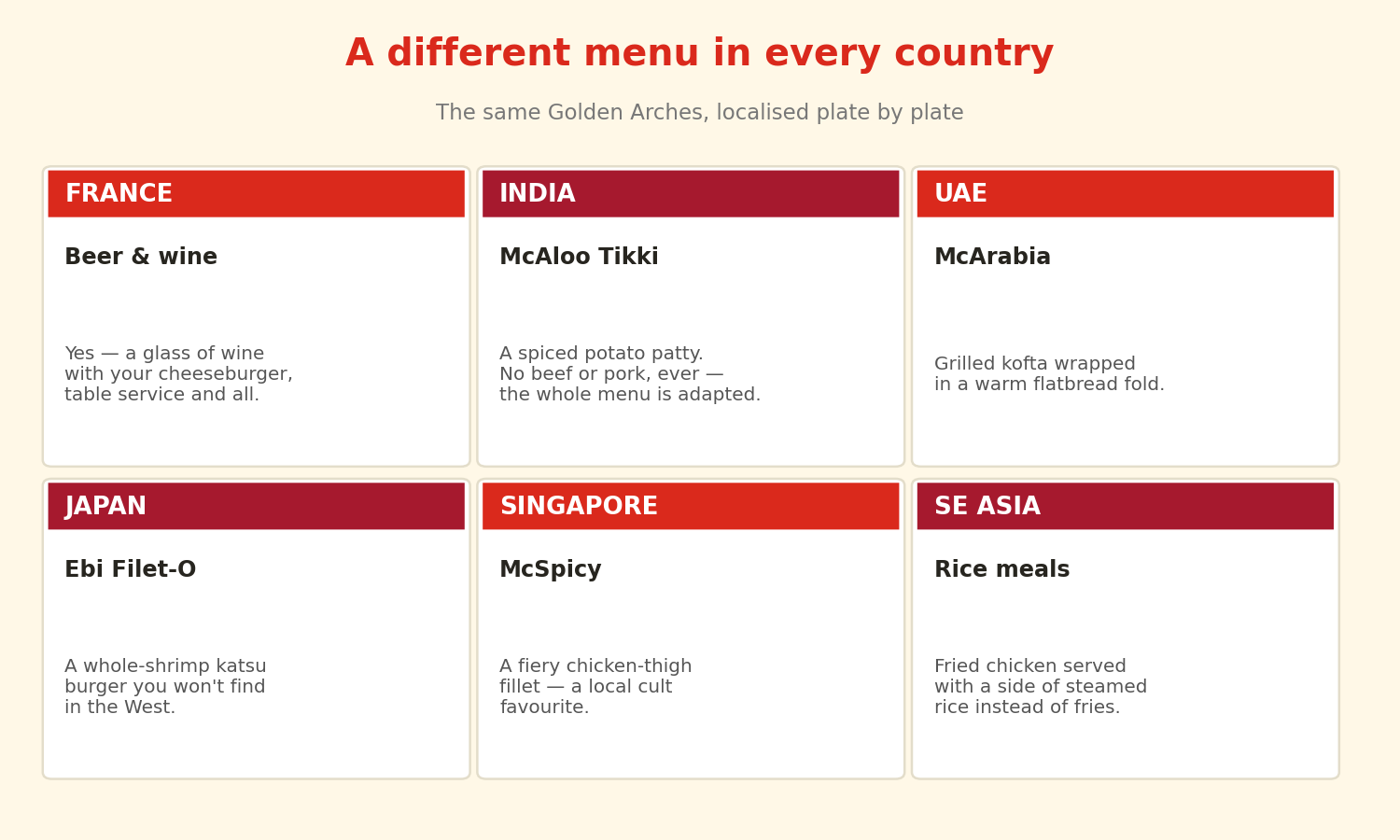
In different countries it has done its cultural conformities. In India there is no pork or beef served at all, to align with the Muslim and Hindu populations, being halal in every country it needs to be.
One funny thing is that in France they have taken it to the next level by offering beer and even wine! You could in theory have table service and wine with your double cheeseburger in France. The beer part also applies to many countries in the Schengen area… until you cross the channel back to the UK & Ireland and realise that Mahou is not served in stores here. Though I can imagine the mayhem in the UK by having a couple beers in Maccies after a night out… let's ave it.
There's also food that's more "familiar" to what people eat locally. In the Emirates you have the McArabia, which is like a fold over wrap; the McAloo Tikki in India; the Ebi Prawn and Filet-o-Fish burgers in Japan; the McSpicy in Singapore; and even rice served in South East Asian branches!
Where the Golden Arches don't reach
One of the main things I noticed is that if you map McDonald's restaurant presence against a list of highest to lowest GDP per capita, there's a strong correlation.
There are over 43,000 McDonald's restaurants in the world, but they're far from evenly spread. The US, China and Japan alone account for more than half of them.
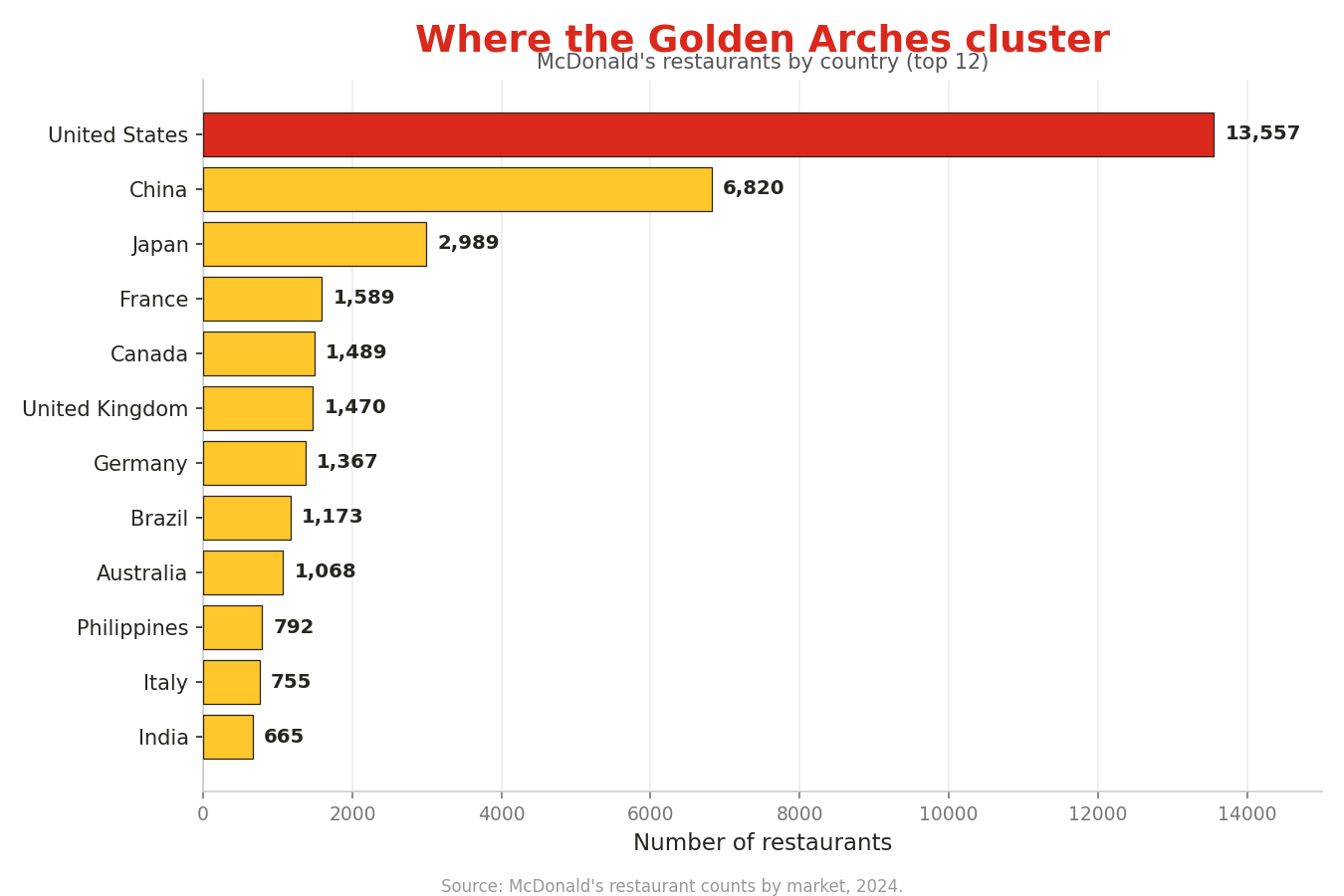
And the gaps are just as telling as the clusters.
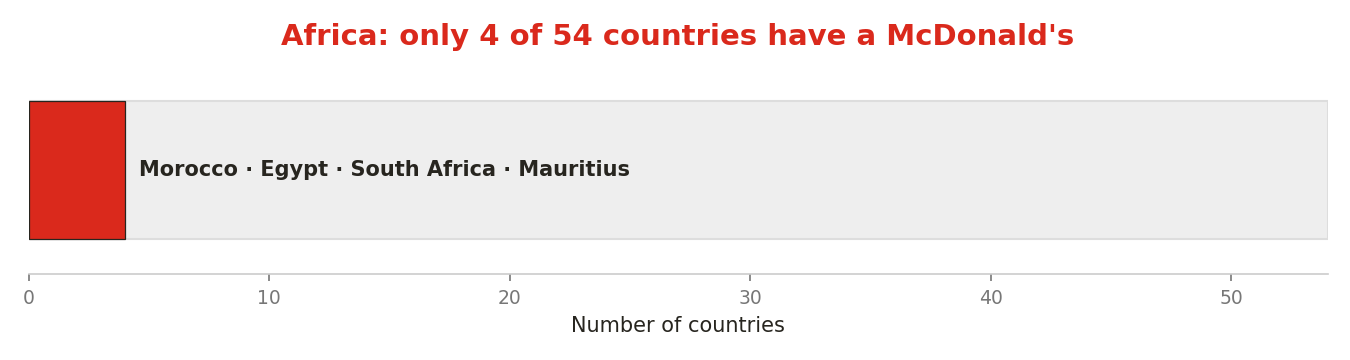
In the huge continent of Africa there are only 4 countries — Morocco, Egypt, South Africa and Mauritius — which have a presence. Even in African powerhouses like Nigeria or Ghana there isn't one; this is attributed to supply chain issues.
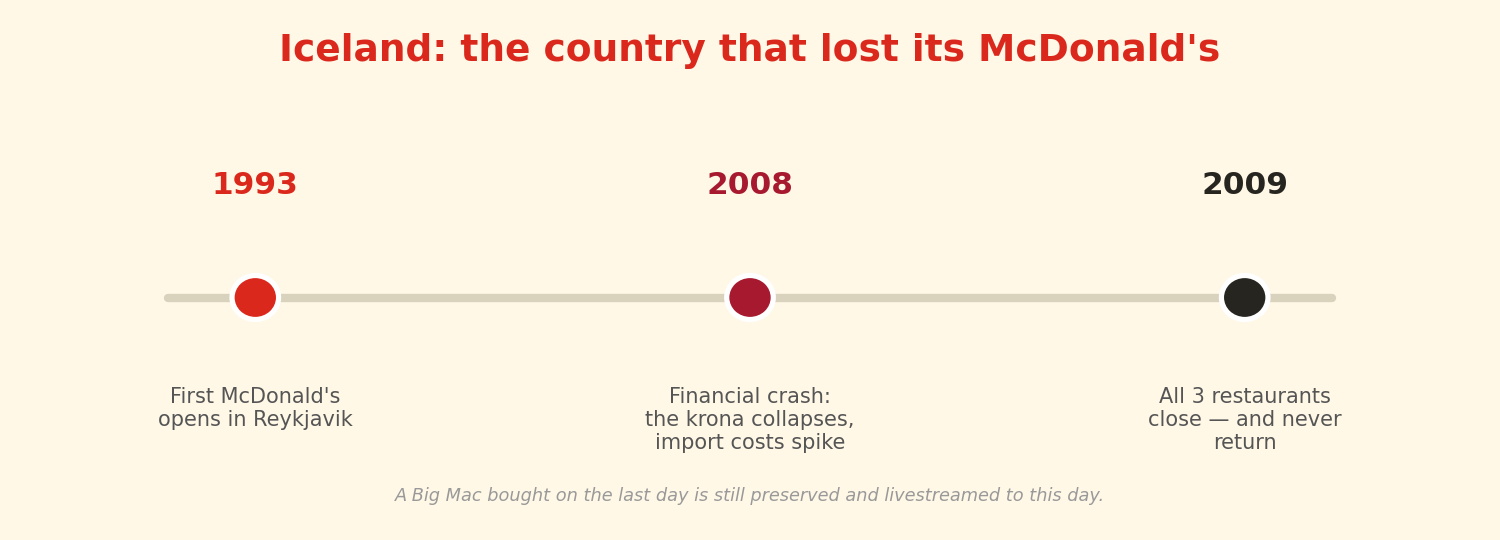
In places such as Iceland, they had it for years until 2009, when the financial crash spiked huge import costs and it never recovered. Places like Bermuda had heavy restrictions on new fast food chains, despite a demand for it.
The bottom line
So next time someone recommends having Maccies abroad, remember that it can also be a scoop into that country's cuisine. Those beautiful Golden Arches mean different things to different people. Next time you bite into your Big Mac, give a light thought to how one man's trash could actually be another man's treasure…
Cheers all, nothing else from me.
💬 Comments
Got a thought on this one? Leave a comment below.
0 Comments
No comments yet. Be the first!